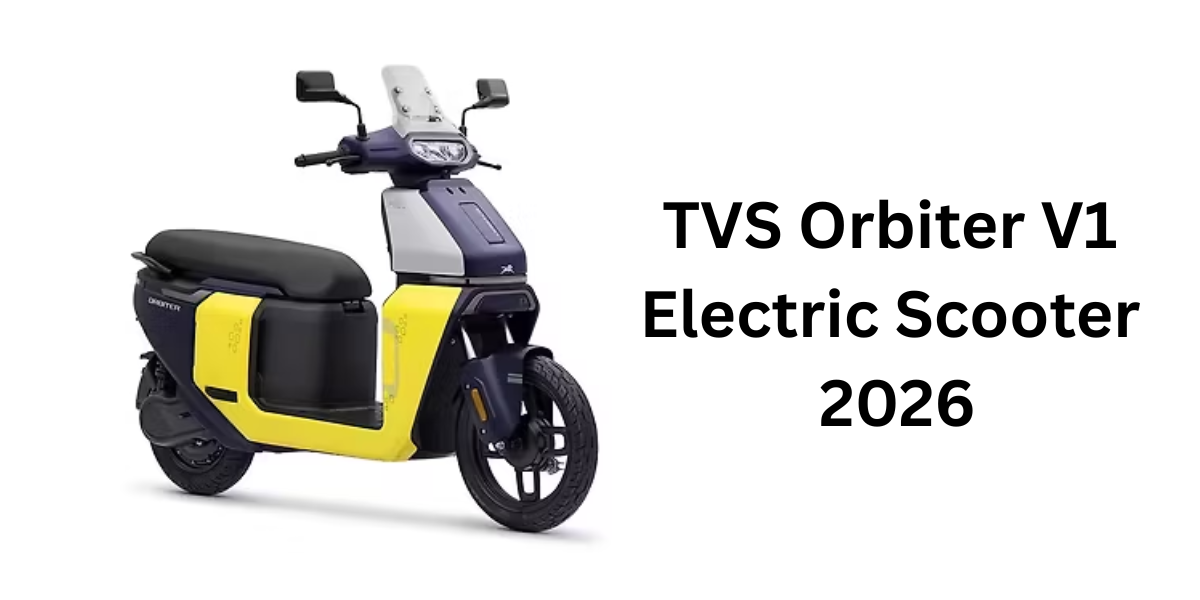
The freshest development is the launch of the TVS Orbiter V1, widely reported on March 12–13, 2026, with a pricing hook designed to make buyers do a double take. Multiple recent reports say the scooter starts at ₹49,999 ex-showroom under the BaaS model, while the battery-inclusive ex-showroom price is ₹84,500 in Delhi. That is not a minor pricing tweak; that is a strategic hammer blow aimed squarely at the affordability conversation in India’s EV space. The V1 is reported to use a 1.8 kWh battery pack, with an IDC-claimed range of 86 km, and TVS is using the BaaS framework to reduce upfront cost and widen the buyer funnel. It is the kind of move that turns a product from “interesting” into “wait, should I actually buy this?” overnight.
At the same time, the Orbiter V2 continues to shape the perception of the lineup because TVS’s official Orbiter page still presents a higher battery variant with a 3.1 kWh pack, IDC range of 158 km, and a 68 km/h top speed for the Orbiter family. The official page also highlights features like 34-litre twin-helmet storage, a connected mobile app, and a practical urban design. Put simply, V1 grabs attention with entry pricing, while V2 preserves the “I want more range and fewer charging worries” appeal. This split gives TVS a two-lane strategy: one lane for first-time EV adopters and budget-sensitive commuters, and another for buyers who care more about range confidence and everyday flexibility. That is why even if someone searches for TVS Orbiter VI Electric scooter 2026, the real news story is broader than one badge. It is about how TVS is building a ladder into EV ownership, one rung at a time.
TVS Orbiter Lineup Explained
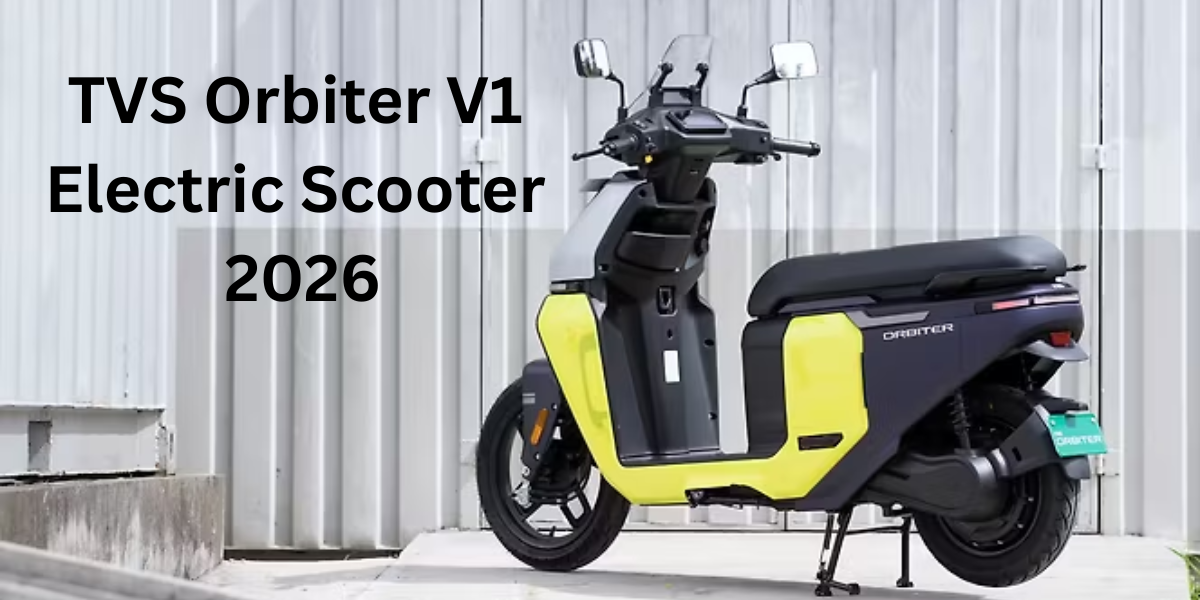
To understand the current conversation, it helps to think of the Orbiter lineup like a smartphone family. You do not just buy a name; you buy a battery size, a usage style, and an ownership model. The Orbiter V1 appears to be the newer, affordability-led variant built around a 1.8 kWh battery, targeted at urban riders who want a lower entry point into electric mobility. With an 86 km IDC range and the option to use Battery-as-a-Service, it makes sense for short daily commutes, office runs, college travel, and small family errands. That makes it less about bragging rights and more about solving a simple but expensive city problem: daily transport that does not bleed fuel money every week.
Then there is the Orbiter V2, the variant that TVS officially presents with a 3.1 kWh battery and 158 km IDC range. This is the version that better supports riders who want extra room in their routine, whether that means longer commutes, more confidence between charges, or just fewer mental calculations before leaving the house. TVS also promotes practical details such as 34L storage, app connectivity, and a comfort-first design approach, signaling that Orbiter is not trying to be an edgy niche toy. It is designed to fit real life: groceries, backpacks, rainwear, traffic, and the endless stop-start rhythm of Indian roads. That practical positioning is a strength because the electric scooter market is no longer just about early adopters and tech fans. It is about normal households making normal buying decisions.
As for the exact phrase TVS Orbiter VI Electric scooter 2026, caution is the smart path. No official TVS source found in the current search set identifies a separate “VI” model. The most plausible reading is that the search term is either a typo, shorthand, or naming confusion around V1 and the 2026 updates. That does not make the keyword useless from an SEO angle; quite the opposite. It means strong content should acknowledge the search intent, clarify the naming, and then guide readers toward verified information on Orbiter V1, Orbiter V2, pricing, range, and BaaS. In SEO, relevance is not just matching words; it is matching the reader’s real question. Here, the real question is simple: What is the latest on TVS Orbiter in 2026, and is it worth considering?
Price, Battery, and Range Breakdown
The most useful way to view the Orbiter in 2026 is through a side-by-side comparison, because electric scooter decisions are rarely emotional for long. At some point, every buyer becomes an accountant with a helmet. Price, battery size, charging time, and range begin to matter more than flashy launch headlines. Based on the official TVS Orbiter pages and recent coverage, the current picture looks like this: the Orbiter V1 emphasizes lower upfront cost and BaaS-enabled flexibility, while the Orbiter V2 appears tuned for higher range and broader daily usability. Those two models create a fairly clean split inside the same product family, which is useful for buyers who want an easy shortlist rather than a maze of overlapping trims.
| Variant | Battery | Claimed Range | Top Speed | Charging Time (0–80%) | Price Insight |
| TVS Orbiter V1 | 1.8 kWh | 86 km (IDC) | Not consistently specified across all sources | 2h 20m | ₹49,999 with BaaS / ₹84,500 ex-showroom Delhi with battery |
| TVS Orbiter V2 | 3.1 kWh | 158 km (IDC) | 68 km/h | 4h 10m | Official Orbiter family pricing pages position it above V1; marketplace listings vary by city |
The pricing strategy here is the real story. TVS is not merely selling a scooter; it is changing how a buyer enters the EV ecosystem. The BaaS model removes a big portion of the initial sticker shock by splitting the vehicle and battery costs. TVS says BaaS offers a structured monthly payment model, nationwide availability, and an extended battery warranty of up to 5 years or 70,000 km depending on variant, with no monthly kilometre cap according to the official BaaS page. That changes the buying equation for people who have always liked EVs in theory but hated the upfront math in practice. Think of it like moving from buying an entire home entertainment system at once to paying for the screen now and streaming the expensive bits in a more manageable way. It lowers resistance, and lower resistance often becomes higher adoption.
Still, buyers should read the fine print and not get hypnotized by the headline price alone. A low entry number is powerful, but ownership value depends on how long you ride, how often you charge, what your subscription terms look like, and whether your commute really fits the claimed range. IDC figures are useful benchmarks, but daily real-world riding conditions can vary based on traffic, speed, payload, terrain, and weather. A commuter covering short city distances may love the V1’s cost structure, while a rider who often stretches the daily route may feel safer paying more upfront for the larger-battery variant. That is why the best Orbiter is not the cheapest one on paper; it is the one that creates the least friction in your actual routine. The smart buyer should compare total ownership cost, not just the showroom headline.
Features, Ownership Experience, and Market Position
What makes the Orbiter interesting is that TVS is not pitching it as a futuristic luxury gadget floating above real life. It is being framed as a practical city companion, and that is exactly where many Indian EV buyers live emotionally. The official TVS messaging points to a minimalistic design, a spacious straight-line footboard, a connected digital display, navigation and app integration, and 34L twin-helmet storage on the range-oriented version. Those are not random brochure fillers. They are answers to the small annoyances that shape daily riding: where do I keep my stuff, can I ride comfortably in traffic, will the app actually help me, and does this machine fit family use as well as solo commutes? In crowded urban mobility, convenience is king and underseat space is practically a constitutional right.
There are also signs that TVS wants the Orbiter to feel mature rather than experimental. The official Orbiter page mentions 600+ rigorous safety tests, while the owner’s manual snippet surfaced in search references a cruise control feature. Although buyers should verify exact feature availability by variant and city before purchase, the broad signal is clear: TVS is trying to build trust around the product, not just curiosity. That matters because electric scooters still face a perception hurdle among mainstream users who worry about battery life, service readiness, safety, and resale. A brand like TVS has an advantage here because it already has existing market familiarity and dealership presence. In a category where people often ask, “Will this still make sense two years from now?”, brand reassurance can matter almost as much as range figures.
From a market-positioning angle, the Orbiter family sits in a very deliberate gap. It is not trying to outshout premium performance-led EVs, and it is not pretending to be a bare-bones compromise machine either. Instead, it seems tuned for mass-market urban practicality, the kind of scooter that aims to be easy to recommend to a sibling, spouse, or parent. That is often where real scale comes from. Premium halo products grab headlines, but practical value products move the market. The Orbiter V1 in particular looks like TVS’s attempt to widen the entry ramp to electric ownership, while the V2 preserves choice for buyers who want more distance from a single charge. If that balance holds in real ownership reviews, the Orbiter family could become one of the more strategically important TVS EV plays of 2026.
Who Should Consider the Orbiter in 2026
The TVS Orbiter VI Electric scooter 2026 keyword may be fuzzy, but the buyer profile around the Orbiter family is actually pretty clear. This scooter makes the most sense for city commuters, college students, office-goers, small families, and first-time EV buyers who want a machine that feels usable rather than intimidating. If your riding pattern is mostly urban, predictable, and repetitive, the Orbiter’s value proposition starts looking strong. Daily work commutes, local market trips, tuition runs, metro station transfers, and neighborhood errands are exactly the sort of tasks where electric scooters shine. They turn repeated short trips into a cost-saving loop. One ride does not change your life, but hundreds of rides change your monthly budget.
The V1 is likely the better fit for riders whose number one concern is entry cost. The BaaS-backed price point pulls the Orbiter into conversations that might otherwise default to lower-cost ICE scooters or used two-wheelers. That is a big deal in a market where adoption is often blocked not by interest but by financing comfort. The V2 is better suited to those who want higher range, fewer charging interruptions, and more flexibility in a week full of unpredictable travel. So the choice is not simply “Which one is better?” It is “Which one matches the shape of your life?” Buying the wrong battery size is a bit like buying shoes that look great in the box but hurt after ten minutes on the road. A scooter has to fit your schedule the way shoes fit your feet.
Potential buyers should also compare the Orbiter with nearby rivals in the affordable and mid-range EV space, especially on service access, warranty, software usability, financing, and long-term battery economics. Headline range and launch price might get all the applause, but ownership satisfaction often comes from the boring details: charging ease, support availability, claim handling, and how consistent the vehicle feels after months of use. This is where official brand pages, owner documentation, and major automotive publications become more valuable than random hype posts. A careful buyer should use the current 2026 coverage as a launchpad, then cross-check variant availability in their city and dealer network before making a final call. The Orbiter looks promising, but buying any EV without local verification is like planning a road trip with half a map.
Conclusion
The biggest truth about the TVS Orbiter VI Electric scooter 2026 is that the current real-world news story points more clearly to the TVS Orbiter V1 launch and the expanding Orbiter family than to a separately verified “VI” variant. That is not a weakness for this topic; it is the key insight. The Orbiter conversation in 2026 is being driven by aggressive entry pricing, the rollout of Battery-as-a-Service, official claims of 86 km to 158 km IDC range depending on variant, and a practical feature set aimed squarely at everyday Indian urban mobility. TVS appears to be building an EV lineup that speaks less like a tech fantasy and more like a budget-conscious, utility-minded commuter solution. For many buyers, that is exactly the right language.
What makes the Orbiter family worth watching is not just that it exists, but that it seems carefully aimed at the heart of the market. The V1 lowers the first barrier: upfront cost. The V2 answers the next question: range comfort. Together they create a ladder into EV ownership that may appeal to first-time buyers, family users, and commuters who want a known brand with a more manageable pricing model. Anyone researching this keyword should treat “VI” cautiously, verify official variant naming, and focus on the confirmed 2026 developments around Orbiter V1, Orbiter V2, pricing, range, and BaaS. Right now, the Orbiter story feels less like a single launch and more like the opening move of a bigger affordability push from TVS in India’s electric scooter space. That makes it relevant not just for shoppers, but for anyone tracking where the EV market is heading next.
Read also : NBEMS GPAT 2026 Answer Key 2026