Quantitative Measurement of Bacterial Growth

Quantitative Measurement of Bacterial Growth

The term growth in microbiology indicates the magnitude of total population. Microbial growth measurement is essential for: Determining the growth and reproduction rate, Determining the suitability of water, milk, and food for human consumption, Counting microflora of soil, Monitoring the fermentation process, Checking the suitability of raw material for preparing pharmaceutical products, and Checking the

Quantitative Measurement of Bacterial Growth Read More »
Cytoplasm and Cytoplasmic Inclusions

Cytoplasm and Cytoplasmic Inclusions

Structure enclosed by the cell membrane is known as cytoplasm, which is aqueous, semitransparent, elastic, and thick. Cytoplasm consists of 80% water and remaining 20% include proteins (enzymes), carbohydrates, lipids, inorganic ions, and many low-molecular weight compounds. In the cytoplasm, most of the vital chemical reactions (metabolism) of the cells take place. In prokaryotic cytoplasm, the major structures

Cytoplasm and Cytoplasmic Inclusions Read More »

Gram Negative Cell Wall

Gram Positive and Gram Negative Cell Wall

Gram-Positive Bacterial Cell Wall Cell wall of gram-positive bacteria (figure), is approximately 80nm thick having several layers of peptidoglycan. Peptidoglycan : It contributes to 50−90% of the dry weight of the cell wall. It is thicker, stronger, and extensively cross-linked than gram-negative bacteria, in which peptidoglycan comprises of 5−10% of the wall material. Peptidoglycan layer is thin in

Gram Positive and Gram Negative Cell Wall Read More »

Ultrastructure of Bacterial Cell

Ultrastructure of Bacterial Cell – Pedagogy Zone

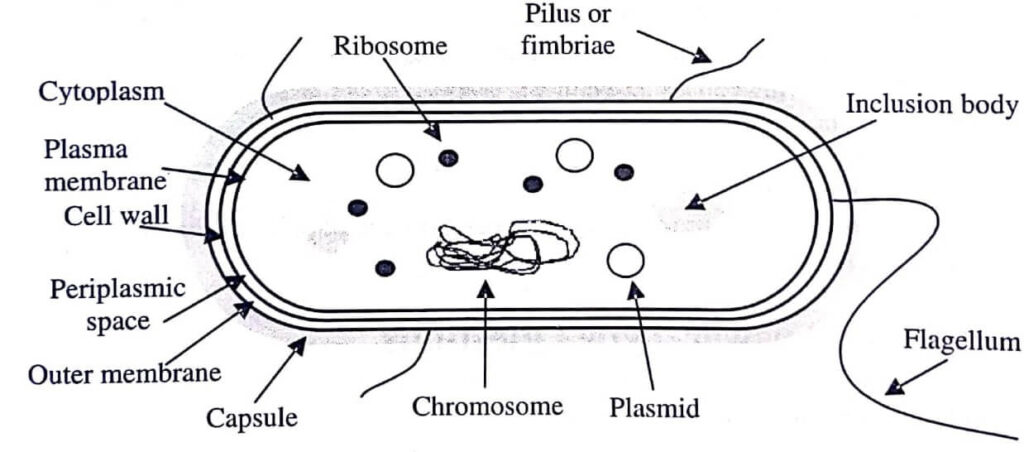
Despite of being the most primitive and simplest microorganism, bacteria have well developed cell structures which possess many unique biological properties. Bacteria differ from archae bacteria and other eukaryotic microorganisms in many ways. Due to their simplicity, bacteria had been studied thoroughly on the genetic level, revealing many biochemical and genetic principles that have been

Ultrastructure of Bacterial Cell – Pedagogy Zone Read More »

Difference Between Prokaryotes and Eukaryotes

Difference Between Prokaryotes and Eukaryotes

Table enlists the distinguishing features between prokaryotes and eukaryotes : Difference between Prokaryotic and Eukaryotic Cells Basic Prokaryotes Eukaryotes Typical Organisms Bacteria and archaea Protists, fungi, plants and animals. Typical Size ∼1-10μm ∼10-100μm (sperm cells, apart from the tail, are smaller). Types Nucleus Nucleoid region; no real nucleus Real nucleus with double membrane. DNA Circular

Difference Between Prokaryotes and Eukaryotes Read More »