January 2023

Gram Negative Cell Wall

Gram Positive and Gram Negative Cell Wall

Gram-Positive Bacterial Cell Wall Cell wall of gram-positive bacteria (figure), is approximately 80nm thick having several layers of peptidoglycan. Peptidoglycan : It contributes to 50−90% of the dry weight of the cell wall. It is thicker, stronger, and extensively cross-linked than gram-negative bacteria, in which peptidoglycan comprises of 5−10% of the wall material. Peptidoglycan layer is thin in

Gram Positive and Gram Negative Cell Wall Read More »
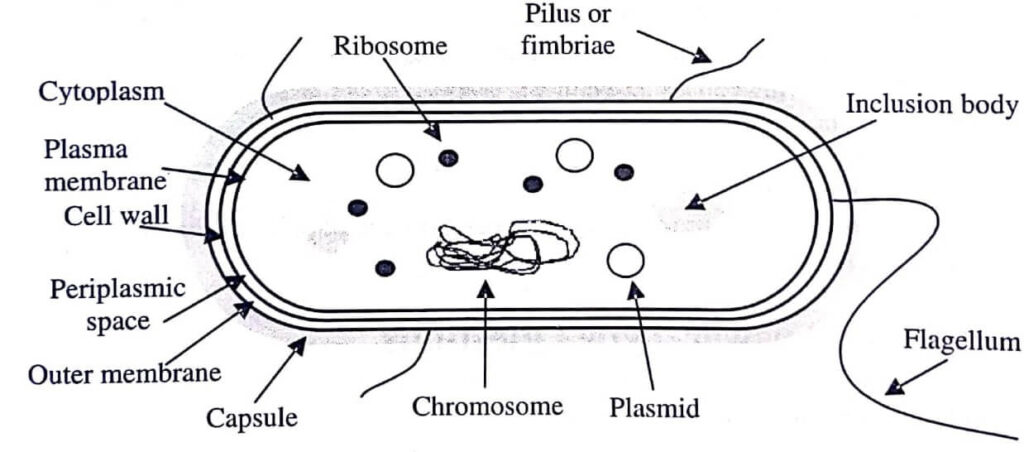
Ultrastructure of Bacterial Cell

Ultrastructure of Bacterial Cell – Pedagogy Zone

Despite of being the most primitive and simplest microorganism, bacteria have well developed cell structures which possess many unique biological properties. Bacteria differ from archae bacteria and other eukaryotic microorganisms in many ways. Due to their simplicity, bacteria had been studied thoroughly on the genetic level, revealing many biochemical and genetic principles that have been

Ultrastructure of Bacterial Cell – Pedagogy Zone Read More »

Difference Between Prokaryotes and Eukaryotes

Difference Between Prokaryotes and Eukaryotes

Table enlists the distinguishing features between prokaryotes and eukaryotes : Difference between Prokaryotic and Eukaryotic Cells Basic Prokaryotes Eukaryotes Typical Organisms Bacteria and archaea Protists, fungi, plants and animals. Typical Size ∼1-10μm ∼10-100μm (sperm cells, apart from the tail, are smaller). Types Nucleus Nucleoid region; no real nucleus Real nucleus with double membrane. DNA Circular

Difference Between Prokaryotes and Eukaryotes Read More »

Typical Prokaryotic Cell

The Prime Features of a Prokaryotic Cell

Examination of a prokaryotic cell reveals various component structures. Some of the structures are naturally common to almost all prokaryotes, but some structures are present in certain species. Structures found external to the bacterial cell wall aid in protection, attachment, motility, or conjugation. Figure shows a typical prokaryotic cell. The prime features of a prokaryotic

The Prime Features of a Prokaryotic Cell Read More »

Drugs Used in Parkinson's Disease

Drugs Used in Parkinson’s Disease – Pedagogy Zone

A slowly progressive and degenerative disease affecting the nervous system is termed Parkinson’s disease (named after its pioneer, James Parkinson in 1817). Parkinson’s disease results from an insufficiency of dopamine in the brain, and is thus categorised as a movement disorder. According to the WHO, a chronic progressive neurodegenerative disorder of insidious onset, characterised by

Drugs Used in Parkinson’s Disease – Pedagogy Zone Read More »

Aqueous Humour Secretion and its Pathway

Drugs Used in Glaucoma and Types of Glaucoma

Glaucoma is defined as a progressive optic neuropathy causing damage to optic nerves that result in visual field defects. The disorder is progressive in nature and is usually associated with increase in intraocular pressure (normal intraocular pressure ranges from 1020mmHg). Therefore, management of glaucoma aims at decreasing the raised intraocular pressure which can be achieved

Drugs Used in Glaucoma and Types of Glaucoma Read More »

Drugs Used in Myasthenia Gravis – Pedagogy Zone

Myasthenia Gravis (MG) is an autoimmune disorder, in which antibodies are produced at neuromuscular junction (NMJ) against the NM receptors, so, it results in decrease in the number of NM receptors. Patients with myasthenia gravis show severe muscular weakness. The degree and intensity may vary at different times. Patients with thymoma show an increased risk of development

Drugs Used in Myasthenia Gravis – Pedagogy Zone Read More »