Direct sequence spread spectrum BPSK transmitter or encoder

Direct Sequence Spread Spectrum with Coherent BPSK

In the previous subsection we studied the baseband transmission of direct sequence spread spectrum modulated signal. For long distance transmission or transmission over a satellite channel, BPSK can be used. DS-SS BPSK Transmitter Fig. shows the transmitter of Direct Sequence Spread Spectrum with BPSK. The multiplier multiplies the two signals b(t) and c(t). The output

Direct Sequence Spread Spectrum with Coherent BPSK Read More »

Model of the spread spectrum digital communication system

Spread Spectrum (SS) Techniques – Pedagogy Zone

Necessity of Secure Communication There are some applications where it is necessary for the system to resist external interference and to make it difficult for unauthorized receivers to receive the message being transmitted. This type of communication is called secure communication such that noise interference and unwanted receivers should not detect the message. Such communication

Spread Spectrum (SS) Techniques – Pedagogy Zone Read More »

Line Coding

Line Coding in Communication Engineering – Pedagogy Zone

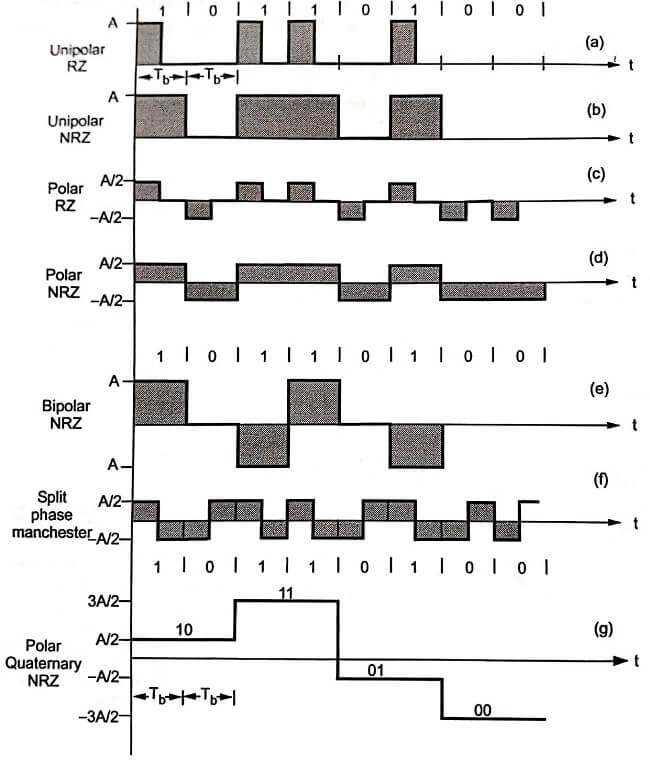
The analog waveforms are converted to digital signals by PCM, DM, ADM, DPCM etc. techniques. This digital data can be represented by different formats or waveforms. These waveforms are commonly known as digital data formats or their representation is called as line coding. Digital symbols can amplitude modulate some carrier to generate amplitude modulated pulse

Line Coding in Communication Engineering – Pedagogy Zone Read More »

Angle modulation

Comparison Between Amplitude Modulation and Angle Modulation

Angle modulation has following advantages over amplitude modulation (AM): The amplitude of FM is constant. It is independent of depth of modulation. Hence transmitter power remains constant in FM whereas in FM it varies in AM. Since amplitude of FM is constant, the noise interference is minimum in FM. Any noise superimposing an amplitude can

Comparison Between Amplitude Modulation and Angle Modulation Read More »