February 2024

Electrochemistry Solved Problems

Electrochemistry Solved Problems

Here are a few simple electrochemistry solved problems along with their solutions: 1. Calculate the single electrode potential of copper metal immersed in 0.15°MCu2+ solution. E° for copper is +0.34 V at 25°C. Solution: By Nernst equation [latex] \mathrm{E}=\mathrm{E}^{\circ}+\frac{0.0592}{\mathrm{n}}\left[\log \mathrm{M}^{\mathrm{n}+}\right] at 25^{\circ} \mathrm{C} [/latex] [latex] \begin{aligned} & =0.34+\frac{0.0592}{2} \log [0.15] \\ & =0.34+\frac{0.0592}{2}(-0.8239)=0.3156 \mathrm{~V} \end{aligned} [/latex] 2. Calculate the electrode potential of

Electrochemistry Solved Problems Read More »

Electrochemical Series

Electrochemical Series (or) Electromotive Series

Definition : When elements are arranged in increasing order of their standard reduction electrode potentials, the series so obtained is known as electrochemical (or) electromotive series. or A series in which standard reduction potentials of various electrodes are arranged in the order of increasing reduction potentials (largest reduction potential at the top) or decreasing oxidation

Electrochemical Series (or) Electromotive Series Read More »

Simple galvanic cell

Definition and Construction of Electrochemical Cell

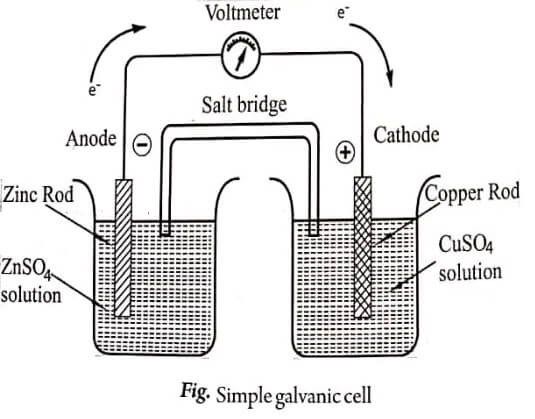
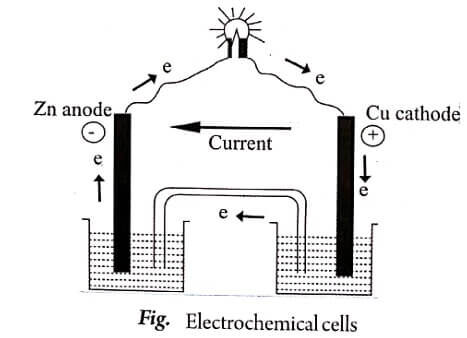
The cells used for electrolysis are called electrolytic cells while those used for generation of electrical energy from chemical reactions are called galvanic or voltaic cells. The practical application of a galvanic cell is Daniel cell. The electrode where oxidation occurs is called anode and the electrode where reduction occurs is called cathode. John Daniell

Definition and Construction of Electrochemical Cell Read More »

Sodium Potassium Pumps

How Do Sodium Potassium Pumps Work

Sodium-potassium pumps, also known as Na+/K+-ATPases, are integral membrane proteins responsible for maintaining the electrochemical gradient across cell membranes. This gradient is vital for numerous cellular functions, including nerve signal transmission, muscle contraction, and nutrient uptake. Structure of Sodium-Potassium Pumps At the structural level, sodium-potassium pumps consist of several subunits, including alpha and beta subunits.

How Do Sodium Potassium Pumps Work Read More »

Electrochemical cells

Difference Between Electrolytic Cells and Electrochemical Cells

A cell is a device for the conversion of electrical energy into chemical change or vice versa. It is a system containing two metallic electrodes, dipped into the same or different electrolytes, connected by an external metallic conductor. Types of cells The cells are classified into two types: Electrolytic cells. Electrochemical cells. Electrolytic cells These

Difference Between Electrolytic Cells and Electrochemical Cells Read More »