Health Science

Pharmaceutical Applications of Micromeritics

In pharmacy, micromeritics is employed for: Release and Dissolution: Clinically, the particle size and surface area of a drug can affect its release from dosage forms administered orally, parenterally, rectally, and topically. Finely powdered drug has a high surface area, hence gets easily dissolved in dissolution fluids in vivo, thereby enhancing the drug solubility and

Pharmaceutical Applications of Micromeritics Read More »

Emulsions : Introduction, Classification – Pedagogy Zone

A biphasic liquid preparation containing two immiscible liquids, one of which is dispersed as minute globules into the other, is termed as pharmaceutical emulsion. The liquid in the form of minute globules is the dispersed phase, while the liquid containing the dispersed globules is the continuous phase. An emulsifying agent is added to disperse two

Emulsions : Introduction, Classification – Pedagogy Zone Read More »

flocculated and deflocculated suspension

Formulations of Flocculated and Deflocculated Suspensions

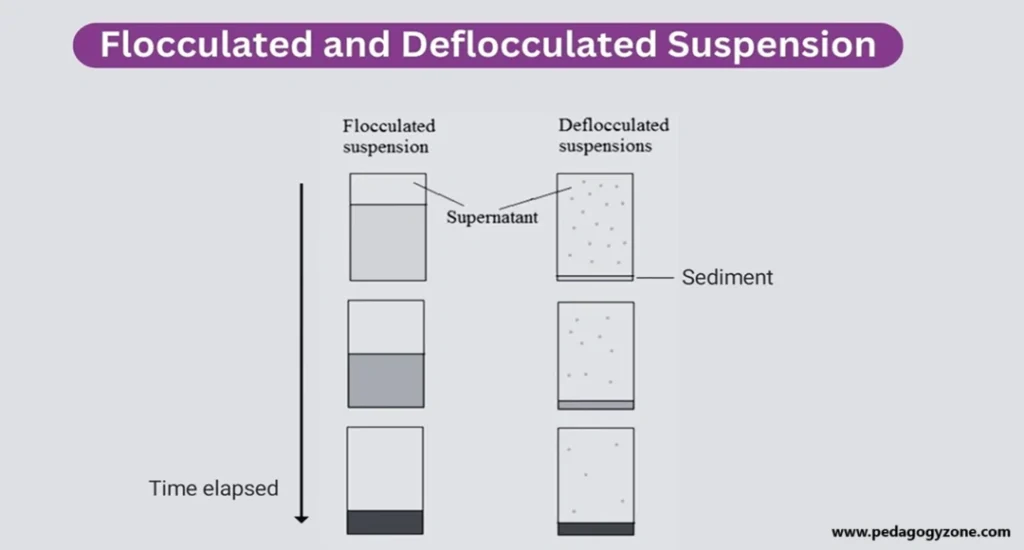
Flocculated and deflocculated suspension: The formulation of a suspension possessing optimal physical stability depends on whether the particles in suspension are to be flocculated or to remain deflocculated. First approach involves use of a structured vehicle to keep deflocculated particles in suspension; a second depends on controlled flocculation as a means of preventing cake formation.

Formulations of Flocculated and Deflocculated Suspensions Read More »

flocculated and deflocculated suspension

Flocculated and Deflocculated Suspensions

Flocculated and deflocculated suspension: The solid drug is crushed into smaller particles and then dispersed in a dispersion medium in order to prepare a suspension. As a result of crushing, the surface area of particles and their associated surface free energy increases. This makes the system thermodynamically unstable with highly energetic particles which regroup and

Flocculated and Deflocculated Suspensions Read More »

Classification of Dispersed Systems and Their General Characteristics

The dispersion system is categorised in the following three groups based on the size of dispersed particles: Molecular Dispersion: This system behaves as true solutions where the solute phase is present in the solvent phase. The solute (dispersed phase) is homogeneously distributed as separate molecules of size below 1nm (10-7 cm) throughout the solvent (dispersion

Classification of Dispersed Systems and Their General Characteristics Read More »