Physics

Ferromagnetic Materials 2

Classification of Ferromagnetic Materials

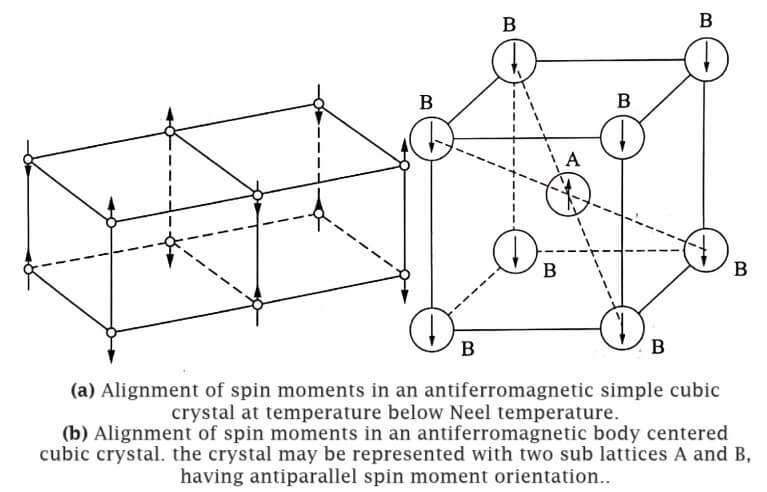
Based on permanent magnetic dipoles, materials are further classified into Antiferromagnetic materials Ferrimagnetic materials Antiferromagnetic materials Definition: When the magnitudes of all the antiparallel aligned magnetic dipoles of a material are equal and the resultant magnetisation becomes zero, the material is called antiferromagnetic material. Examples: Manganese oxide (MnO), Chromium oxide (Cr2O3), Ferrous oxide (FeO), etc. This is

Classification of Ferromagnetic Materials Read More »

Soft material and Hard material

Difference Between Soft & Hard Magnetic Materials

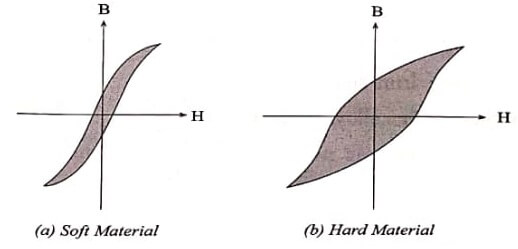
Based on the area of the hysteresis loop, the magnetic materials are classified into soft and hard magnetic materials. Generally the magnetic materials are classified into two types. They are Soft Magnetic materials Hard Magnetic materials Soft Magnetic materials These are materials which are easily magnetized and demagnetised. They are also called as temporary magnets.

Difference Between Soft & Hard Magnetic Materials Read More »

Hysteresis loop

Explanation of Hysteresis Loop on the Basis of Domain Theory

Hysteresis Loop: The word hysteresis literally means lagging behind. “Hysteresis is the phenomenon of lagging of magnetic induction (B) behind the magnetising field (H) of a ferromagnetic material when the specimen is at critical temperature. It is also defined as when a ferromagnetic material is taken through a cycle of magnetisation, the variation of B (magnetic

Explanation of Hysteresis Loop on the Basis of Domain Theory Read More »

Exchange energy in ferromagnetism

Domain Theory of Ferromagnetism – Pedagogy Zone

Weiss put forward a second hypothesis, namely domain hypothesis. He postulated that the atomic dipole of an atom strongly interacts to the neighbouring atom by a quantum mechanical interaction called exchange interaction. He explain why a sample of ferromagnetic material has spontaneous magnetisation. Explanation The entire ferromagnetic volume splits into a large number of small

Domain Theory of Ferromagnetism – Pedagogy Zone Read More »

Comparision Chart for Dia, Para and Ferro-Magnetic Materials

S.No Diamagnetic Material Paramagnetic Material Ferromagnetic Material 1. It is a material in which there is no permanent dipole moment (or) magnetic moment in each atom. The external magnetic field decrease the magnetic induction present in the specimen. It is material in which there is permanent dipole moment in each atom. External magnetic field increases

Comparision Chart for Dia, Para and Ferro-Magnetic Materials Read More »

Effect of magnetic field in diamagnetic material

Definition and Properties for Diamagnetism

Definition: “Materials which does not have permanent magnetic dipoles” are termed as Diamagnetic materials. or The substances which when placed in a magnetic field become weakly magnetised in a direction opposite to that of the applied magnetising field are called diamagnetic substances. Examples: Gold, Quartz, Water, Copper, Zinc, Germanium, Silver, Lead, Silica, Helium, Bismuth etc.,

Definition and Properties for Diamagnetism Read More »