Physics

Difference Between Intrinsic and Extrinsic Semiconductors

Difference Between Intrinsic and Extrinsic Semiconductors

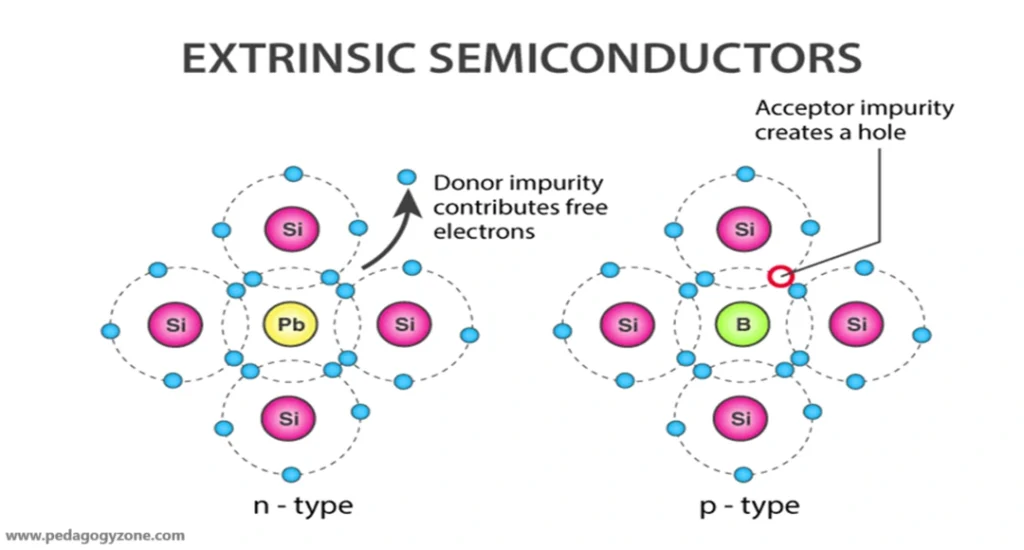
S.NO Intrinsic semiconductors Extrinsic semiconductors 1. Semiconductor in a pure form is called intrinsic semiconductor. Semiconductor which are doped with impurity is called extrinsic semiconductor. 2. Here the charge carriers are produced only due to thermal agitation Here the charge carriers are produced due to impurities and may also be produced due to thermal agitation.

Difference Between Intrinsic and Extrinsic Semiconductors Read More »

Variation of carrier concentration with temperature

Variation of Carrier Concentration with Temperature

The variation of carrier concentration with temperature for a n-type semi conductor is shown in Fig. At 0K both the conduction band and valence band are free from any charge carriers and hence conductivity is zero. Now, when the temperature is slowly increased, the donor atoms get ionized and hence, the electron concentration in conduction band increased.

Variation of Carrier Concentration with Temperature Read More »

Difference Between N & P Type Semiconductor

S.No. n-type semiconductor p-type semiconductor 1. N-type semiconductor is obtained by doping an intrinsic semiconductor with pentavalent impurity. P-type semiconductor is obtained by doing an intrinsic semiconductor with a trivalent impurity. 2. Here electrons are majority carriers and holes are minority carriers. Here holes are majority carriers and electrons are minority carriers. 3. It has

Difference Between N & P Type Semiconductor Read More »

Electrical Conductivity

Electrical Conductivity (σ) – Pedagogy Zone

The electrical conductivity is defined as the rate of electric charges flows across a unit area in a unit time per in a conductor per unit potential gradient (or) electric field. It is denoted by σ. [latex] \begin{aligned} \sigma & =\frac{\mathrm{Q}}{\mathrm{AtE}} \quad\left(\text { Since } \mathrm{J}=\frac{\mathrm{I}}{\mathrm{A}}: \mathrm{I}=\frac{\mathrm{Q}}{\mathrm{t}}: \mathrm{J}=\frac{\mathrm{Q}}{\mathrm{At}}\right) \\ \sigma & =\frac{\mathrm{J}}{\mathrm{E}} \mathrm{ohm}^{-1} \mathrm{~m}^{-1} \end{aligned}

Electrical Conductivity (σ) – Pedagogy Zone Read More »