Physics

Atomic arrangement in solids

Classification of Solids – Crystal Physics

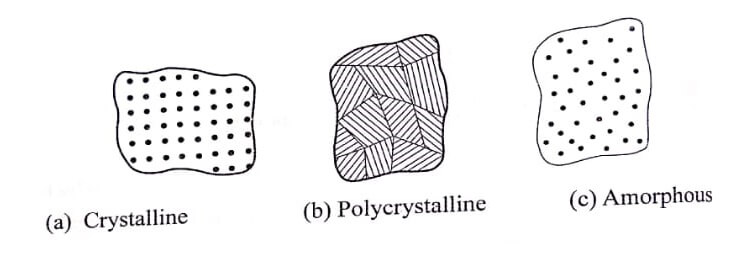
Based on the crystal structure point of view, the solids can be classified into two categories namely: Crystalline (or) Crystals and Non-crystalline (or) Amorphous solids. Crystalline solids or Crystals Crystalline solids (or) crystals are those in which atoms (or) molecules are arranged in some systematic (or) regular pattern. In these materials, the arrangement of atoms

Classification of Solids – Crystal Physics Read More »

Dielectric Materials – Questions and Answers

1. What is a dielectric material? State their property. Dielectrics are the insulating materials having electric dipole moment permanently or temporarily by applying the electric field. These are mainly used to store electrical energy and used as electrical insulators. All dielectrics are electrical insulators. But all electrical insulators need not to be dielectrics. Dielectrics are

Dielectric Materials – Questions and Answers Read More »

Magnetic & Superconducting Materials – Questions and Answer

1. What is meant by magnetic materials? Give examples? Magnetic materials are the materials which can be easily magnetized by keeping it in an external magnetic field. Examples: Iron, Ferrites, Carbon steel etc. 2. Define Magnetic Flux [φ] The total number of magnetic lines of force passing through a surface is known as magnetic flux.

Magnetic & Superconducting Materials – Questions and Answer Read More »

Semiconducting Materials – Questions and Answers

1. What is a semiconductor? The materials in which the electrical conductivity lies between conductors and insulators are called semiconductors. They have resistivity value between 10-4 to 0.05 ohm-m. The electrical conductivity of semiconductor increase when we add impurities and by increasing the temperature and it is contrary to the metals. 2. Define the properties

Semiconducting Materials – Questions and Answers Read More »

Conducting Materials – Questions and Answers

1. What is a conducting material? The material possessing higher electrical and thermal conductivities are called conducting materials. The resistance of such materials are very low. The conducting property of a material depends on the number of free electrons. 2. What is meant by a free electron? The electron moves freely in all directions in

Conducting Materials – Questions and Answers Read More »

Applications of Nanomaterials – Pedagogy Zone

Though nano-particles are very small, they are the important materials to built the future world. They have applications almost in all fields as follows Nanomaterials in Energy Production Generating steam from sunlight: The sunlight, concentrated on nanoparticles intended to use sunlight to generate steam for use in running power plants. Producing high efficiency light bulbs:

Applications of Nanomaterials – Pedagogy Zone Read More »