Chemistry

Electrochemistry Solved Problems

Electrochemistry Solved Problems

Here are a few simple electrochemistry solved problems along with their solutions: 1. Calculate the single electrode potential of copper metal immersed in 0.15°MCu2+ solution. E° for copper is +0.34 V at 25°C. Solution: By Nernst equation [latex] \mathrm{E}=\mathrm{E}^{\circ}+\frac{0.0592}{\mathrm{n}}\left[\log \mathrm{M}^{\mathrm{n}+}\right] at 25^{\circ} \mathrm{C} [/latex] [latex] \begin{aligned} & =0.34+\frac{0.0592}{2} \log [0.15] \\ & =0.34+\frac{0.0592}{2}(-0.8239)=0.3156 \mathrm{~V} \end{aligned} [/latex] 2. Calculate the electrode potential of

Electrochemistry Solved Problems Read More »

Electrochemical Series

Electrochemical Series (or) Electromotive Series

Definition : When elements are arranged in increasing order of their standard reduction electrode potentials, the series so obtained is known as electrochemical (or) electromotive series. or A series in which standard reduction potentials of various electrodes are arranged in the order of increasing reduction potentials (largest reduction potential at the top) or decreasing oxidation

Electrochemical Series (or) Electromotive Series Read More »

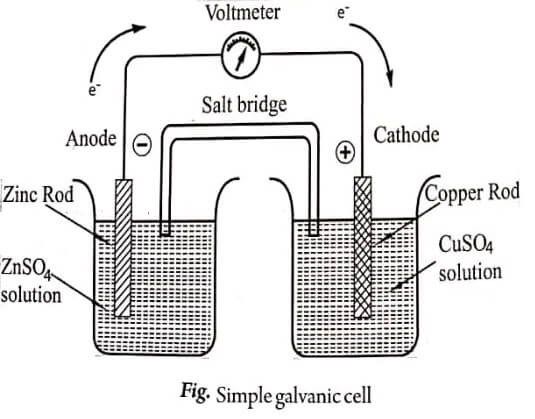
Simple galvanic cell

Definition and Construction of Electrochemical Cell

The cells used for electrolysis are called electrolytic cells while those used for generation of electrical energy from chemical reactions are called galvanic or voltaic cells. The practical application of a galvanic cell is Daniel cell. The electrode where oxidation occurs is called anode and the electrode where reduction occurs is called cathode. John Daniell

Definition and Construction of Electrochemical Cell Read More »