Health Science

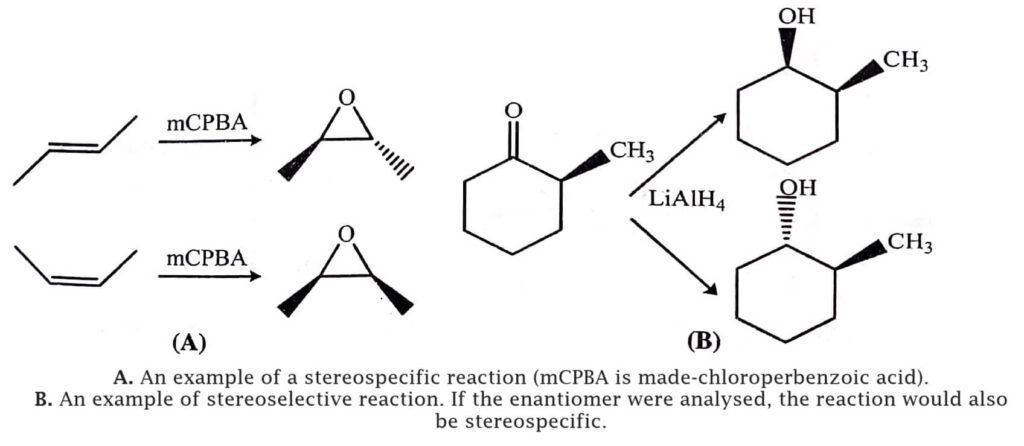
Stereospecific Reaction

Stereospecific and Stereoselective Reactions

In stereospecific reactions, one stereoisomer of the product is obtained if one stereoisomer of the reactant is present, while different stereoisomers of product are obtained when different stereoisomer of the reactant are present. Thus for determining whether a reaction is stereospecific or not, one has to analyse the product ratio from the different stereoisomer of

Stereospecific and Stereoselective Reactions Read More »

Conformational Isomerism – Pedagogy Zone

Conformational isomerism: Isomers resulting from different arrangements of the atoms in space due to the rotation of groups around C-C bond axis are known as conformational isomers. The study of these confirmations or conformational isomers is known as conformational analysis which involves analysis of the shapes that molecules can adopt by rotation about single bond.

Conformational Isomerism – Pedagogy Zone Read More »

Photolytic Degradation and its Prevention

Photolytic degradation is the degradation of photodegradable molecules caused by the absorption of photons, particularly those wavelengths found in sunlight, such as infrared radiation, visible light, and ultraviolet light. Some molecules get activated by the heat of light which increases the reaction rate. Drugs which get chemically degraded in the presence of light are photosensitive

Photolytic Degradation and its Prevention Read More »

Pharmaceutical Applications of Micromeritics

In pharmacy, micromeritics is employed for: Release and Dissolution: Clinically, the particle size and surface area of a drug can affect its release from dosage forms administered orally, parenterally, rectally, and topically. Finely powdered drug has a high surface area, hence gets easily dissolved in dissolution fluids in vivo, thereby enhancing the drug solubility and

Pharmaceutical Applications of Micromeritics Read More »